There is a particular kind of exhaustion that comes from publishing content that disappears.
You put together a beautiful LTK collection. You style the flat lay, film the try-on, write the caption. You post it to Instagram at 11am because that is when the algorithm supposedly wants it. And by Thursday, it is gone. Not just buried, gone, as in functionally nonexistent to anyone who was not already following you and happened to be online that Tuesday.
This is not a content quality problem. It is a platform physics problem.
For LTK creators, specifically, this distinction matters more than it does for almost any other type of publisher. Your content has a long natural shelf life on Pinterest. A well-curated fall wardrobe roundup does not expire after 48 hours. A guide to affordable home decor under $200 will be relevant again next season, and the season after that. The question is not whether that content has lasting value. It clearly does. The question is whether you are putting it somewhere that can actually deliver it to people over time.
Most LTK creators are not. And the gap between where that content lives and where it could live is exactly where the opportunity is.
What Pinterest Actually Is (and Why That Changes Everything for LTK)
Pinterest is not social media. It behaves like a search engine with a visual interface, and once you understand that distinction, the entire platform starts to make more sense.
When someone opens Instagram, they are looking to see what is happening. They are in a scrolling, social, reactive mode. When someone opens Pinterest, they are looking for something specific, or at least something directional. They might type “transitional weather outfit ideas” or “cozy home office decor” or “gift ideas for women who have everything.” They are in a searching, planning, shopping mode.
That difference in intent is significant for anyone with affiliate links to share.
A person who is actively searching for “fall capsule wardrobe essentials” and lands on your well-optimized Pin is far closer to a purchase decision than a person who passively scrolls past your outfit post while waiting for their coffee. Both people might eventually click, but the Pinterest user came to the platform with the problem already in mind. Your LTK links are the solution they were already looking for.
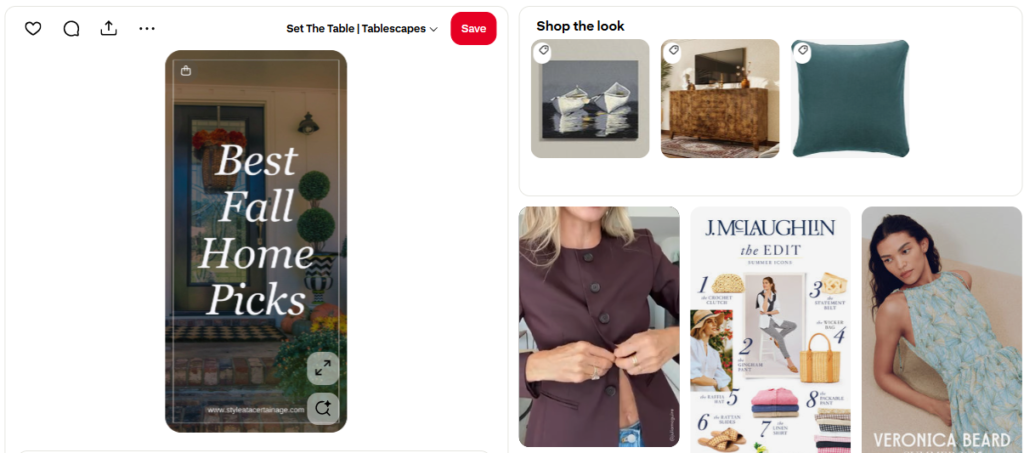
There is also a compounding quality to Pinterest visibility that does not exist on most other platforms. A Pin published today might get modest reach this week, more reach next month as it picks up saves and engagement signals, and potentially its highest reach six months from now if it hits a seasonal search surge. The platform rewards relevance over time, not just recency. For LTK creators with existing content archives, this is a meaningful unlock.
How LTK and Pinterest Actually Work Together
The technical question of whether you can link from Pinterest to LTK gets asked often, and the answer is yes, with some nuance worth understanding.
LTK links, meaning direct links to your LTK shop or individual collections, can be shared on Pinterest. Pinterest accepts them as destination URLs. However, the most durable and conversion-friendly approach is not to link directly from a Pin to your LTK shop. It is to link to a blog post or landing page that contains your LTK widget, and let that intermediate page do some of the trust-building work first.
Here is why that structure tends to perform better:
Pinterest users arrive cold. They have not been following you for months. They do not know your aesthetic or your recommendation track record. A direct link to a shop asks them to buy from a stranger. A link to a genuinely useful post, something like “10 Fall Outfits That Actually Work for Real Life” or “How I Decorated My Home Office for Under $500,” gives them a reason to trust you before they click through to purchase.
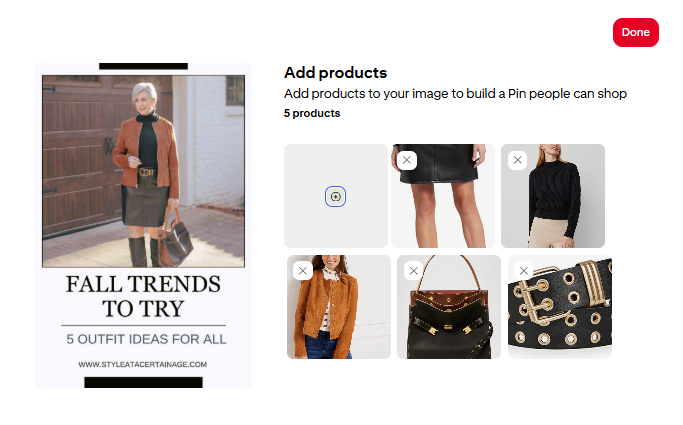
The Pin is the discovery. The blog post is the relationship. The LTK widget is the conversion point. That three-step sequence is much more resilient than asking Pinterest to skip directly to a sale.
A note on Pinterest’s own shopping features: Pinterest has been expanding its native shopping capabilities, including shoppable Pins with tagged products and product catalogs. These work differently from LTK links and can be layered into a Pinterest strategy in complementary ways. Some creators use both: shoppable Pins for individual product discovery, and blog-linked Pins for roundups and editorial content. Neither replaces the other.
What LTK Content Performs Well on Pinterest
Not all LTK content translates to Pinterest equally. Some formats are genuinely well-suited to how the platform works. Others are just Instagram content in the wrong place.
The content types that tend to perform consistently well for LTK creators on Pinterest:
Curated roundups with a specific angle. “10 Minimalist Work Outfits” performs better than “My Favorites This Month” because it answers a specific search intent. The more specific and searchable the angle, the more likely someone will find it who actually wants exactly that.
Seasonal and evergreen hybrid content. Content that is seasonal in frame but recurring in nature, think “How to Style Boots This Fall” or “The Best Lightweight Jackets for Spring,” can be repinned and resurface across multiple years. These are among the highest-ROI Pins to create.
Home, lifestyle, and fashion roundups with strong visual composition. Pinterest is a visual search engine, which means the image quality and layout of your Pin graphic matters for both human clicks and algorithmic distribution. Collage-style product roundups, lifestyle photography with text overlays, and vertical graphics (the 2:3 ratio is the platform standard) all tend to perform well.
“Best of” and comparison content. “Best Affordable Alternatives to [Designer Piece]” or “Amazon vs. Pottery Barn: What’s Actually Worth It” taps into a searcher who is already comparison shopping. These Pins often have high outbound click rates because the user’s intent is already commercial.
What tends to underperform:
Single outfit shots with no context or text overlay. Behind-the-scenes content that relies on existing follower familiarity. Pins with vague titles like “Loving This Look” that give the search algorithm nothing to work with. Content that was clearly designed for Instagram Stories and repurposed without any optimization.
The core question to ask about any piece of LTK content before you Pin it: if someone typed a phrase into Pinterest search, would this Pin show up as a useful answer to what they were looking for? If yes, Pin it. If no, rethink the framing before you do.
The Keyword Layer That Most Creators Skip
This is where most Pinterest strategies for LTK creators fall apart, not in the content itself, but in how the content is described.
Pinterest uses keyword signals from Pin titles, descriptions, board names, and the text on the Pin graphic itself to understand what a piece of content is about and when to surface it. If those fields are vague or empty, the algorithm has nothing to distribute it against.
The creators who see consistent traffic growth from Pinterest are usually doing something methodical with their keyword research. They are thinking about what their ideal reader would actually type into a search bar, not what sounds good as a caption, and building their Pin titles and descriptions around those phrases.
Some practical examples of the difference:
Caption logic: “Obsessed with this fall look, everything linked!”
Search logic: “Fall Work Outfit Ideas for Women: Chic But Comfortable”
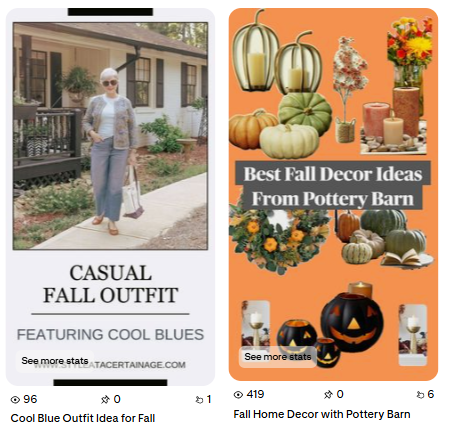
One is written for people who already like you. The other is written for people who have never heard of you but have exactly the problem you solve.
The description field on a Pin is another overlooked opportunity. Pinterest reads description text to understand content relevance, but most creators either leave it blank or paste in their Instagram caption. A few sentences that naturally include relevant search terms, written for a human reader rather than stuffed with keywords, will consistently outperform a blank or caption-copied description.
Board organization matters here too. A Pin about fall home decor saved to a board called “My Stuff” will get less algorithmic distribution than the same Pin saved to a board called “Fall Home Decor Ideas and Inspiration.” The board name is a keyword signal. The board description is another keyword signal. These small choices add up over a large content library.
What Consistent Pinterest Traffic Actually Looks Like
Because Pinterest traffic builds gradually rather than spiking immediately, it can be hard to know whether the strategy is working, especially in the first few months.
A useful frame: Pinterest is more like a publishing archive than a broadcast channel. You are not looking for a spike after each post. You are looking for a slow, steady accumulation of reach across your whole body of content, with certain Pins breaking out and driving disproportionate traffic as they find their search audience.
What healthy Pinterest growth for an LTK creator tends to look like in practice:
Impressions grow week over week as the content library expands and existing Pins accumulate engagement signals. Outbound clicks, meaning clicks to your blog posts or LTK links, increase at a higher rate than impressions as the platform learns which of your content converts. Saves trend upward, because saves are a strong signal to Pinterest that a Pin is worth distributing more widely. And over time, certain Pins emerge as consistent performers that drive traffic for months without any additional promotion.
To put some real numbers on this: a creator with a consistent Pinterest strategy across fashion, beauty, and home niches can reach 240,000 to 280,000+ weekly impressions with steady outbound click growth, often seeing 10-13% week-over-week improvement in outbound clicks even in months when impressions are relatively flat.
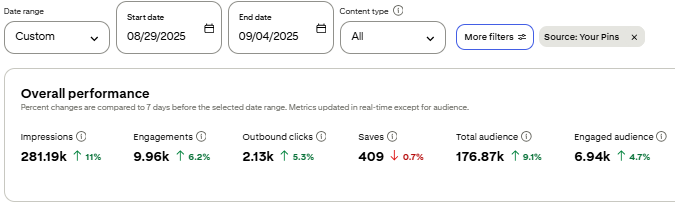
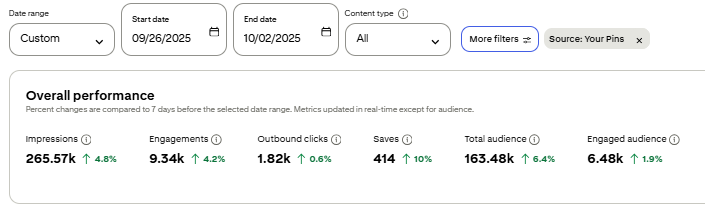
A single seasonal Pin, like a fall home decor collection, can accumulate nearly 700 impressions in its first month and continue growing from there. These are not viral numbers. They are compounding numbers, which over a year of consistent effort add up to a very different kind of reach than a platform that resets every 48 hours.
The Integration Question: Adding Pinterest to an Existing LTK Strategy
The objection that comes up most often from established LTK creators considering Pinterest is reasonable: I already have a system. I have a posting rhythm, a content workflow, an affiliate strategy that works. How much does adding Pinterest actually disrupt that?
Less than most people expect, if it is approached as an amplification layer rather than a new content commitment.
The most sustainable Pinterest strategy for a busy LTK creator is not about creating Pinterest-specific content from scratch. It is about making the content you are already creating discoverable in a new place. The blog posts you are already writing, the roundups you are already curating, the seasonal edits you are already shooting, all of those can become Pinterest Pins with relatively minimal additional effort if the workflow is set up correctly.
What does require thought and intentionality:
The keyword research, done once and used across a content calendar, takes meaningful upfront time but does not need to be redone constantly. The Pin graphic templates, once designed in a style that fits your brand and the platform’s format preferences, become a repeatable production step. The board architecture, built thoughtfully at the start, does not need to be rebuilt every season.
The ongoing maintenance of a Pinterest strategy, once it is set up well, is genuinely lighter than most creators expect. The platform does not require daily presence the way Instagram does. A consistent cadence of new Pins, even just a few per week, is enough to keep the algorithm engaged and the library growing.
That said, the setup phase, getting the account structured correctly, the keyword strategy in place, and the first wave of content optimized, does require expertise and real investment of time. The creators who see the fastest results are usually the ones who either learn the system deeply themselves, from a resource built specifically around Pinterest’s current mechanics, or who hand that setup work to someone who already knows it.
A Few Things Worth Knowing Before You Start
Pinterest penalizes spammy behavior more than most creators realize. Pinning the same URL repeatedly, saving Pins to irrelevant boards, or using keyword stuffing in descriptions can suppress distribution. The platform’s algorithm has gotten significantly more sophisticated in the last few years, and the old tricks, like re-pinning constantly or flooding boards with content, can actively hurt an account.
Pinterest analytics have a delay. Unlike Instagram, where you can see engagement within hours, Pinterest data often takes 24-72 hours to reflect accurately. This matters because it changes how you should interpret early Pin performance. A Pin that looks underwhelming on day one might look very different by day four.
Seasonal content needs to be published early. Pinterest users plan ahead in a way that Instagram users do not. Gift guides for the holidays start getting searched in September. Fall fashion content starts gaining traction in late July. If you are publishing seasonal LTK content at the same time you would for Instagram, you are likely missing the peak search window on Pinterest.
Consistency compounds. A Pinterest account with 200 optimized Pins will almost always outperform an account with 20 excellent Pins and 180 mediocre ones, but both will outperform an account where pinning happens in bursts with long gaps in between. The algorithm rewards accounts that pin regularly, because regular pinning signals an active, trustworthy publisher.
Where This Fits in a Larger Visibility Strategy
Pinterest is not a replacement for Instagram, or for email, or for whatever platform is currently working for you. It is a traffic layer that operates on different timescales and reaches people in a different mode of intent.
The creators who benefit most from Pinterest are usually the ones who already have something to send traffic to: a blog, an email list, a well-organized LTK shop, a set of content that has already proven it can convert. Pinterest is very good at finding new audiences for things that already work. It is less suited to doing the foundational work of proving that something works in the first place.
For LTK creators with an established content library and a proven affiliate approach, that means the infrastructure is already there. Pinterest becomes a way of making sure more people can find it, on their timeline, in their search, at the moment they are already looking for exactly what you create.
That is a different kind of marketing channel than most creators have access to. One that does not ask for daily effort in exchange for daily reach. One that rewards the work you have already done rather than requiring constant new output to sustain it.
It is worth understanding fully before deciding whether or how to pursue it. The mechanics are not complicated once they are explained clearly. The strategy is not out of reach for most established creators. But it is specific enough that getting it right from the start, rather than reverse-engineering it after months of underperformance, makes a meaningful difference in how quickly the compounding starts to show up.