If you have been staring at a pin that used to bring in 40,000 monthly views and now brings in 400, you are not imagining things. And you did not do anything wrong.
Pinterest engineers published a paper in July 2026 that explains the whole thing.
It is called PinEqualizer: Full Funnel Content Exploration and Debiasing System at Pinterest (arXiv 2607.22518). Eighteen Pinterest engineers wrote it. It covers a system they have been rolling out since 2024 across Homefeed, Search, and Related Pins, which together account for 92% of all content impressions on the platform.
Here is what it says, in human words.
The problem Pinterest was trying to fix
Recommendation algorithms have a nasty habit. They reward whatever already has proof.
A pin with two years of saves and clicks looks safe to the algorithm. A pin published eleven minutes ago looks like a coin flip. So the safe pin wins, over and over, even when the new pin is a better answer to what somebody actually searched.
The paper calls this the “rich-get-richer effect.” Pinterest’s own head of search, Kurchi Hazra, described the same thing on a panel back in November 2024. Her team’s biggest headache at the time was keeping results “relevant to the times,” because old content that had racked up engagement kept out-ranking newer, more relevant content.
Left alone, that creates a stale feed. Same pins, same creators, same recipes from 2019. Users get bored, new creators never get a foothold, and the whole content ecosystem calcifies.
PinEqualizer is the fix for your Pinterest Full Funnel Content System.
What the system actually does
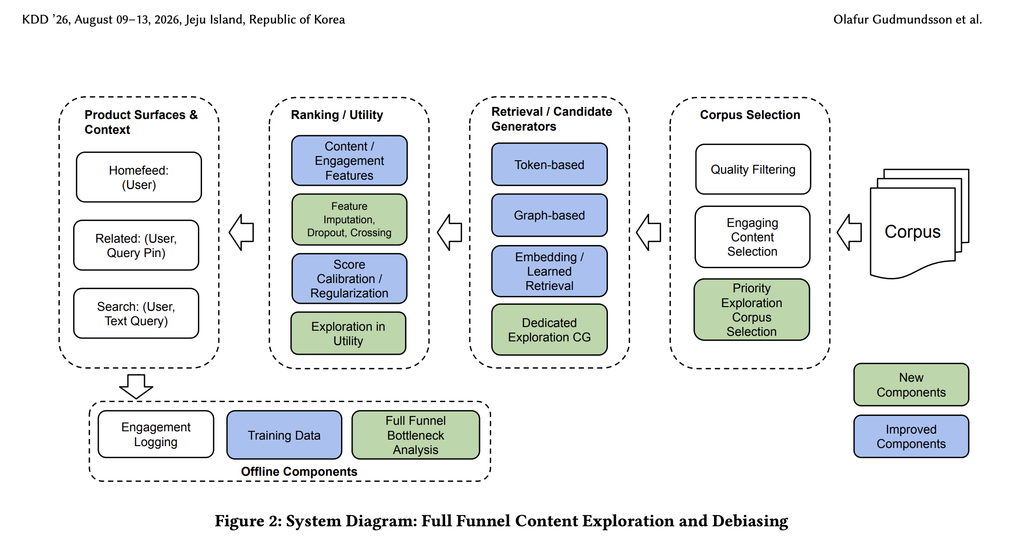
The paper describes four moving parts. Think of it as a lane Pinterest built specifically for content that has not been tested yet.
1. It picks which new pins to test.
Pinterest does not throw traffic at everything new, which would be wildly expensive. Instead it builds an “exploration corpus,” a shortlist of promising fresh pins, chosen partly by an ML model predicting how well a pin should perform and partly by what the account has historically done. Your track record as a creator seeds the guess.
2. It guarantees those pins get into the pipeline.
This is the part people are getting slightly wrong online, so read this bit twice.
Pinterest built separate indices for fresh content and guarantees that a certain volume of fresh candidates enters the ranking pipeline every time. They also rewrote the graph-walk retrieval so that connections leading to unexplored pins get weighted more heavily.
What they did not do is reserve a fixed percentage of the results you see. There is no “slot 4 is always a new pin” rule in this paper.
Plain English version: your new pin now gets an automatic audition. Whether it makes the stage still comes down to the ranking.
3. It stops the ranking model from leaning so hard on engagement history.
This is my favorite part, and the piece with real strategic consequences.
During training, Pinterest deliberately hides a pin’s historical engagement stats from the model on purpose, randomly, pin by pin. They call it engagement feature dropout. The model is forced to figure out whether a pin is good by looking at the pin itself, using content-only signals like the image embedding and the text, rather than by reading the scoreboard.
They also calibrate scores so a fresh pin’s predicted performance sits on the same scale as an established pin’s, instead of being systematically lowballed.
4. It gives new pins a temporary confidence bonus.
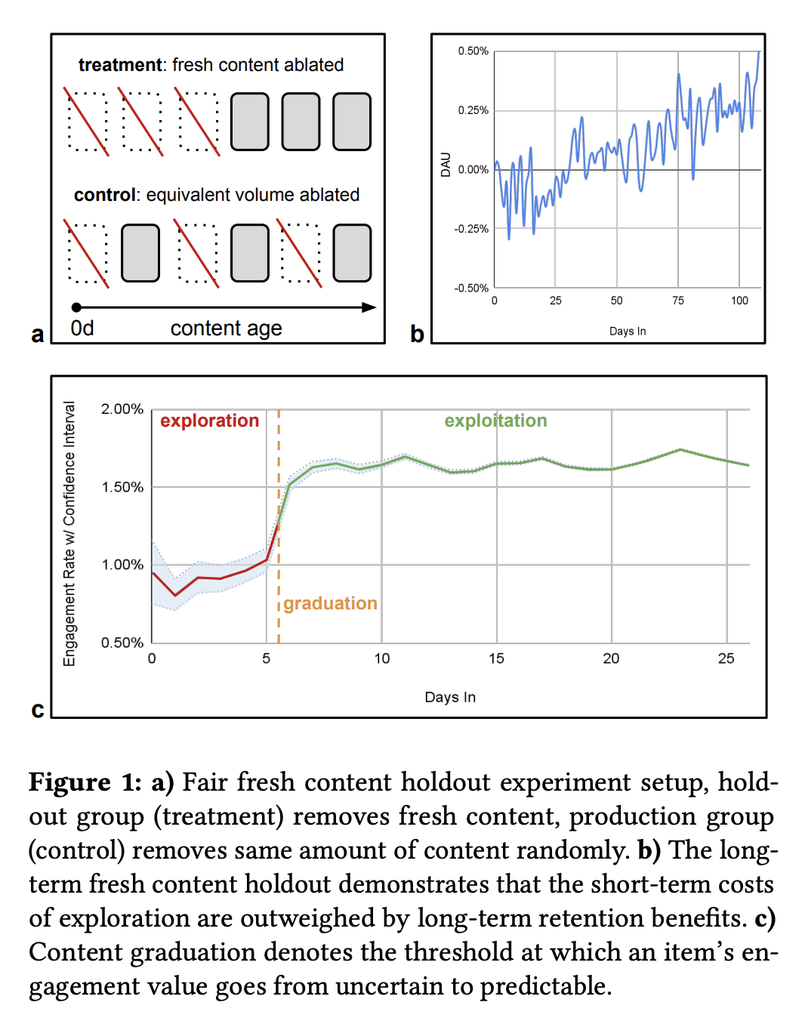
Every fresh pin gets a small boost in the final ranking, sized by how uncertain Pinterest is about it. Fewer impressions means a bigger bonus. As impressions accumulate, the bonus shrinks toward nothing.
On Search specifically, that bonus gets multiplied by the relevance score. A fresh pin that does not match the query well gets almost no boost at all. Pinterest wired that in on purpose so exploration would not wreck search quality.
Graduation
The paper defines a finish line, and I think this is the single most useful concept in the whole document for anyone running a Pinterest strategy.
A pin “graduates” when it earns a set number of positive engagements within a set number of days of being published. At that point Pinterest considers it a known quantity and stops treating it as an experiment. Pins that use up their exploration budget without performing get quietly filtered out of the pool.
Pinterest measures graduation on a 28-day window. That is your audition period.
The results they reported
They ran holdout tests where one group only saw pre-existing content and the comparison group saw fresh content. Year over year, 2025 against 2024:
- Successful sessions up 24% in North America and 49% internationally
- Shopping sessions up 63% in North America
- Content graduating within 28 days up 41%
- Fresh content impressions up 350% cumulatively
- Number of successful content providers up 99%
That last number is the one to sit with. Pinterest roughly doubled the count of accounts earning meaningful engagement, which cuts both ways for you depending on how fast you move.
What this changes about your strategy
Fresh pins for proven URLs are no longer a nice-to-have. Pinterest is actively hunting for new content to test, and it seeds its guess about your new pin partly on your account’s history. A brand new pin pointing at a URL that has already performed is the most favorable setup you can hand this system.
Your first few days now decide everything. The confidence bonus decays with impressions and the graduation window is 28 days. Get those early impressions in front of the right people and the head start turns into permanent standing. Burn them on the wrong audience and the pin gets quietly dropped from the pool.
Relevance gates the whole thing on Search. The boost is scaled by relevance. Vague keywords and clever titles will strangle a new pin before it starts. Say the thing the person typed.
The image and the copy carry more weight than they used to. Since the model is trained to judge fresh pins on content signals instead of engagement history, what is actually on the pin is doing the heavy lifting.
Old pins are not coming back on their own. The paper does not describe any mechanism for re-exploring content that already graduated or already got filtered out. Your 2022 winner is not being re-tested. Make a new pin for that URL.
My honest read on the platform
I think this is good for Pinterest. A feed built entirely from proven content eventually turns into a museum, and a platform nobody new can break into eventually runs out of creators.
That said, I am still seeing the same pins over and over in my own feed, and plenty of results that have nothing to do with what I searched. So the theory is sound and the rollout is real. The lived experience is still catching up.
Either way, we now have the engineering explanation for something a lot of us have been feeling for two years. That is worth something.


